
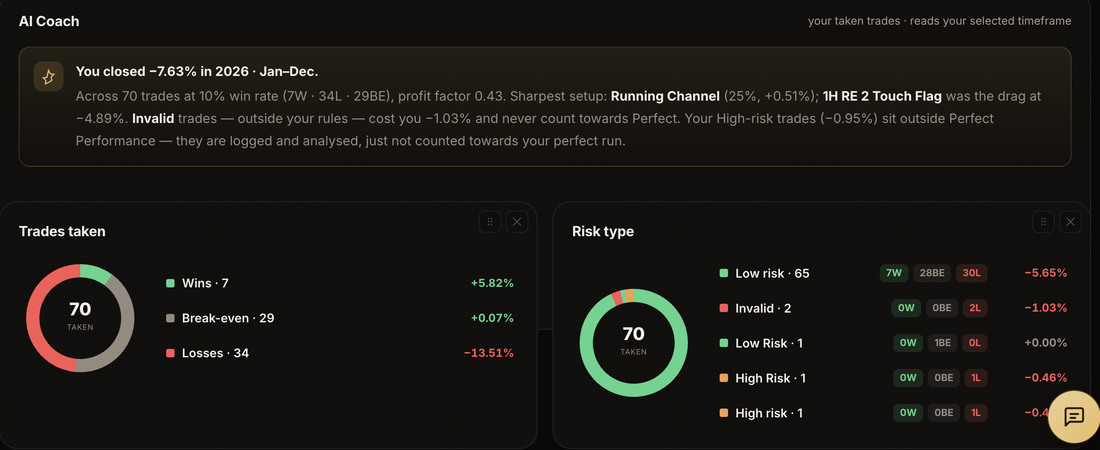

You take a loss. Thirty seconds later you're back in — sized bigger, on a pair you don't normally touch, with no plan beyond “make it back.” If that sequence sounds familiar, you already know how it ends. Some calmer version of you already knew before you clicked.
I've traded FX for seven years and built a platform that logs what several hundred traders actually do, not what they say they do. Revenge trading is one of the most consistent patterns in the data, and it doesn't feel like recklessness from the inside. It feels like conviction.
Markets have been choppier than usual through September — the dollar has had one of its more volatile months of the year, and quick reversals have shown up across most major pairs. Volatility doesn't cause revenge trading, but it hands it more openings: bigger, faster losses, more moments where “just get it back” feels reasonable. Worth reading this before a rough week, not after one.
What revenge trading actually is
It isn't just trading again after a loss — that's normal, everyone does it. Revenge trading is a specific shift: the next trade stops being about the setup and starts being about the loss. There's a simple test afterwards. Would you have taken this exact trade if the last one had been a winner? If the honest answer is no, it wasn't a trade. It was a reaction.
The three shapes it takes
| What it looks like | What you tell yourself | What's actually happening |
|---|---|---|
| Sizing up | “I'm confident in this one, I'll make it back faster” | You're solving for the P&L, not the setup. The size decision came from the loss, not the trade. |
| Re-entering immediately | “The level's still valid, I just got the timing wrong” | No new information has arrived. You're trading the same idea twice because it feels unfinished. |
| Trading outside your plan | “There's a setup on GBP/JPY, I'll just take this one” | You don't normally trade this pair or session. The setup is real; the reason you're taking it isn't. |
Why the urge is so strong
A loss doesn't just cost money — it registers as an unresolved problem, the same part of the brain that won't let you leave a book unfinished or a text unanswered. Behavioural finance calls this loss aversion: a loss hurts roughly twice as much as an equivalent gain feels good, so the pull to neutralise it fast is stronger than the pull toward any ordinary setup. Willpower rarely beats that pull in the moment, because the moment is exactly when your judgement is worst.
The tell: if you can't remember deciding to take the trade — it just felt like the obvious next thing to do — that's the loop talking, not your plan.
Five signs it's already started
- You check your P&L before you check the chart. The trade is being chosen to fix a number, not because of what price is doing.
- You skip the pre-trade checklist you'd normally run. Not because you forgot — because slowing down feels like losing time you need to make back.
- You're trading a pair, session or size you don't usually touch. Familiarity is one of the first things to go.
- The plan for the trade is “get back to breakeven,” not a level or a setup. That's an account-balance target wearing a trade's clothing.
- You notice the urge and log it instead of acting on it. The only one on this list that's a good sign — and it's the whole fix.
The one habit that actually stops it
Every serious write-up on this recommends the same three things: a cooling-off period, a hard stop on trades per day, a rule to walk away after a loss of a certain size. They're all correct, and they all share the same failure mode — they rely on you remembering to follow them at the exact moment you're least equipped to.
The thing that actually works is smaller and more mechanical: write the trade down before you take it, not after. Pair, direction, size, the reason — logged somewhere, before the order goes in. It sounds too simple to matter. It matters because it inserts a fixed delay between the urge and the execution, and the delay is the entire mechanism. A revenge trade that survives being written down first, in your own words, with a real reason attached, usually survives because it was fine all along. Most don't survive the sentence.
This is also why “just be more disciplined” doesn't work as advice — discipline is a resource that's lowest exactly when you need it most. A forced pause doesn't need discipline. It just needs to be the same size every time, so it becomes automatic rather than a decision you have to make freshly under pressure.
The trade you don't take is the one nobody measures
Here's the part that doesn't get talked about. If the pause works and you don't take the trade, that moment disappears completely. It isn't in your broker statement, not in your P&L, not in your win rate. You have no record that you nearly did something expensive and didn't — which means you can never point to evidence that the habit is working, and it's much easier to let it quietly stop.
The fix for that is the same fix as the trade itself: log the setups you talk yourself out of, not just the ones you take. A month of “here's what I nearly did on tilt, and didn't” is some of the most convincing evidence you'll ever have that the process is working — and it's evidence almost nobody keeps, because almost no journal asks for it.
This is the exact gap Exhibit A's missed-trade log was built for — logging what you nearly took and why sits next to the trades you actually took, in the same account. The few seconds it takes to log an urge instead of acting on it is the delay doing its job.
The honest summary
Revenge trading isn't a character flaw and it isn't something you'll think your way out of mid-loss. It's a predictable response to a loss, which means it's interruptible — but only by something mechanical enough to survive the moment your judgement is worst. Write it down first. That's the whole method.
Written 28 September 2026. Exhibit A is a trading journal and analytics tool. Nothing here is financial advice, and no habit, tool or process removes the risk of trading.