
Missing trades is a behaviour problem, not a strategy problem
If you're asking why you keep missing trades, notice what the question already tells you: you saw the setup. The strategy did its job. What failed was the step between spotting the trade and taking it — and that step is behavioural, not technical. Traders spend months tweaking indicators to fix a problem that lives entirely in the moment of hesitation.
The reason it's so hard to fix is that a missed trade leaves no evidence. A losing trade sits in your history demanding attention. A trade you talked yourself out of just quietly disappears — no entry, no P&L, nothing to review. So the pattern repeats, invisibly, because there's nothing on record to make you confront it.
The four reasons good setups get skipped
Almost every missed trade traces back to one of these:
- Hesitation — you wait for extra confirmation and price leaves without you.
- Fear after a loss — a recent drawdown makes the next valid setup feel too dangerous to take.
- No entry plan — the trade wasn't fully defined in advance, so you're deciding under pressure.
- Not being there — the setup triggered while you were away, and without an alert or a plan it passed.
Three of the four are fixable with structure. The fourth — hesitation and fear — only shifts once you can see, in your own numbers, that the trades you're avoiding tend to work out.
Log the trades you didn't take
This is the part almost no journal does, and it's the whole point. A missed valid setup is data, exactly like a trade you took. When you record the trade you skipped — the pair, the level, why you sat out, and what it would have done — two things happen. You start noticing the situations that trigger the freeze, and you build a running tally of what hesitation is actually costing.
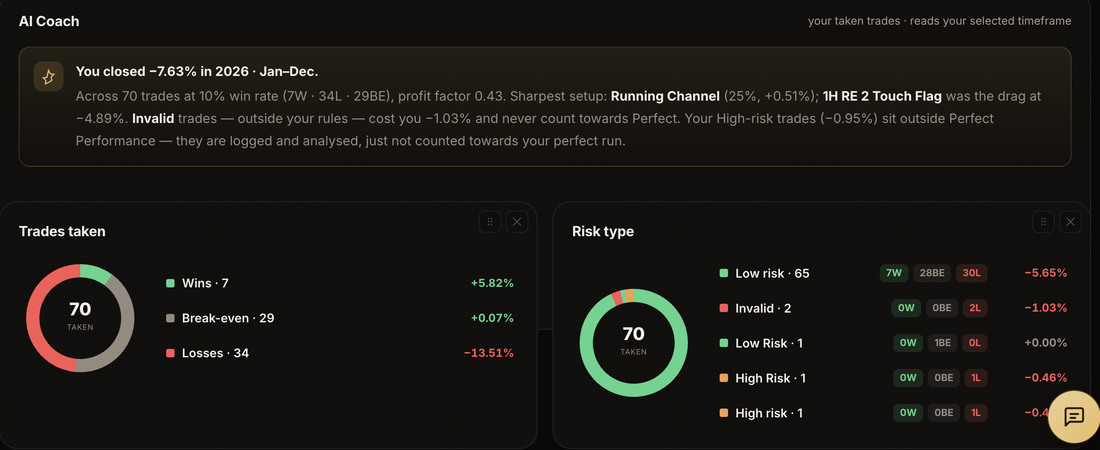
This platform was built around that gap. The trades lived in a Google Sheet, the missed ones and mistakes lived in a separate Notion page, and the two never met — so the cost of skipping trades was never visible in one place. Exhibit A puts taken trades and missed trades in the same journal, so the full picture is finally in front of you.
Put a number on the hesitation
The moment that changes behaviour isn't advice — it's arithmetic. When you can see that the setups you skipped last month would have been net positive, the fear of taking them gets a lot smaller. Exhibit A's missed-trade cost analytics adds up what your skipped valid trades would have returned and shows it next to your real P&L. The gap between "what I made" and "what my strategy made" is usually the most expensive number in your whole account — and the most fixable.
How to stop missing trades, practically
- Write the trade before it triggers. Entry, stop and target defined in advance, so there's no decision left to make in the moment.
- Pre-size the position. Use the position size calculator so the lot size is settled before price arrives and risk isn't an excuse to hesitate.
- Log every skip. Record the setups you don't take and why — this is the data that exposes the pattern.
- Review the cost weekly. Look at what the missed trades would have done. Seeing the number consistently is what retrains the reflex.
Free for 14 days
One plan contains everything — the journal for taken and missed trades, the position size calculator, missed-trade cost analytics, full breakdowns and the AI review coach. £19 a month or £190 a year, with a 14-day free trial and no card charged until it ends.
FAQ
Why do I keep missing trades I had already spotted?
Because the failure is behavioural, not technical. Hesitation, fear after a loss, no written entry plan, or simply not being at the screen. Since the trade never happens it leaves no record, so the pattern stays hidden until you deliberately log the setups you skip.
How do I stop hesitating on entries?
Define the trade before it triggers and pre-size it so there's no maths in the moment, then log every skip. Once you can see your missed trades would have been net winners, the hesitation shrinks faster than willpower alone manages.
Do missed trades really cost that much?
Often more than your losing trades. The gap between the P&L you took and the P&L your strategy produced can be the biggest leak in the account. If you trade a funded account, the same invisibility problem applies to your drawdown floor — see prop firm drawdown explained. See also the free forex trading journal and, if you're comparing tools, the TradeZella alternative breakdown.