
What is the 1% risk rule?
The 1% risk rule means you never put more than 1% of your account balance at risk on any single trade. If your account is £5,000, the most you'll lose on one trade is £50. If it's £10,000, it's £100. The number moves with your balance, so your risk stays proportional as the account grows or shrinks.
It's deliberately simple, and that's the point. One clear ceiling on every trade removes the in-the-moment temptation to "go bigger on this one" — the decision that quietly ends more accounts than any bad strategy does.
The misunderstanding that trips people up
The 1% rule is about how much you can lose, not how much you commit. It is not "use 1% of your account as margin." Your position size and the leverage behind it can be far larger. What stays fixed at 1% is the money exposed between your entry and your stop loss. Get the stop loss right and the position sizes itself around that 1% ceiling — which is exactly what a calculator handles for you.
Why 1%? The maths of survival
Trading is a game of surviving variance. Even a genuinely profitable strategy will hand you losing streaks — that's normal, not broken. The 1% rule is what makes those streaks survivable:
| Losses in a row | At 1% risk | At 5% risk |
|---|---|---|
| 5 losses | −4.9% | −22.6% |
| 10 losses | −9.6% | −40.1% |
| 20 losses | −18.2% | −64.2% |
The 5% trader is nearly wiped out by a streak the 1% trader barely feels. And recovery is asymmetric: a 20% drawdown needs a 25% gain to get back to even, while a 64% drawdown needs a 179% gain. Small, consistent risk isn't timid — it's what keeps you solvent long enough to win.
How to calculate a 1% risk position
Three inputs and one formula:
- Risk amount — 1% of your balance. £5,000 × 1% = £50.
- Stop distance — how far your stop loss sits from entry, in pips. Say 20 pips.
- Pip value — what one pip is worth per lot for the pair you're trading.
Then: position size = risk amount ÷ (stop in pips × pip value per lot). The wider your stop, the smaller the position has to be to keep the loss at £50 — which is the whole reason you size after you've set your stop, never before.
Doing this by hand on every trade is where discipline slips. The free position size calculator takes your balance, risk percent and stop distance and returns the exact lot size, so a 1% trade takes seconds and you never fudge the number under pressure.
Making the rule stick
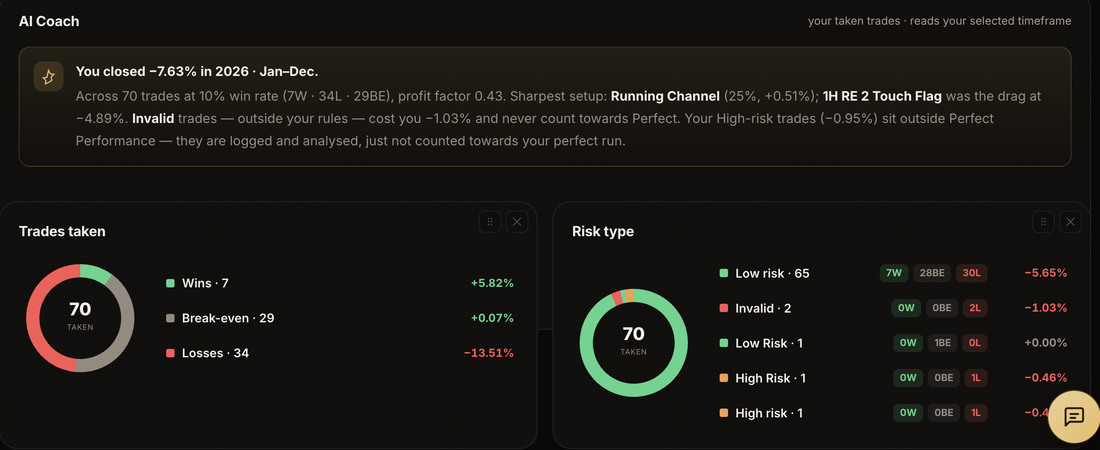
Knowing the rule and following it on trade number 47 after two losses are different things. The habit forms when you can see your behaviour: log the actual risk on every trade and review it. If you set out to risk 1% but keep drifting to 2–3% on setups you "feel good about," the journal shows you — before it costs you a streak. That feedback loop is why sizing and journaling belong in the same place.
FAQ
What is the 1% risk rule in trading?
You never risk more than 1% of your account on a single trade. On a £5,000 account that caps any one loss at £50, so no single trade — or short losing run — can seriously damage the account.
How do I calculate 1% risk per trade?
Take 1% of your balance as the risk amount, then size the position so the entry-to-stop distance equals it: position size = risk ÷ (stop in pips × pip value). The free calculator does it instantly.
Is 1% too conservative?
For most traders, no — it's the standard many professionals and prop firms use. It takes around 20 straight losses to draw down under 20%, which keeps you trading through the variance that sinks bigger-risk accounts.
Where do I log whether I'm sticking to it?
In your journal. See the free forex trading journal, and if hesitation is your issue too, why you keep missing trades.