

A trading journal is a record of every trade you take and, crucially, why you took it — kept so that you can review your own decisions later and find the patterns that are costing you money.
That is the short answer. The longer one matters more, because most people who say they keep a journal are keeping something else.
A journal is not a trade history
Your broker already stores every fill. That is a trade history and it is free. It answers “what happened” perfectly and “why did that happen” not at all.
The six fields, and what each one buys you
Six is the whole list. Tap any of them to see what it tells you — and what you cannot find out without it.
The distinction is not academic. If your record only contains what the broker already knows, reviewing it can only ever tell you which instruments made money last month. That is trivia, not feedback.
What actually belongs in one
Six fields do most of the work. Everything else is optional and most of it is procrastination.
| Field | Why it earns its place |
|---|---|
| Setup name | You cannot measure an edge you have not named. Three or four names is plenty. |
| Planned risk | In percent, decided before entry. The gap between this and what you actually risked is one of the most revealing numbers you will ever calculate. |
| Rule followed? | A yes/no. Splits your results into trades your system took and trades you took. |
| Outcome and R | Result expressed in multiples of risk, not currency. Currency flatters good weeks and hides bad sizing. |
| State | One word. Calm, rushed, annoyed, bored. Feels soft; predicts more than the setup does. |
| Missed setups | The trades you identified and did not take. Almost nobody records these, and for most traders they are the larger of the two books. |
If you only add one thing, add the last one. A journal of trades taken tells you about your system. A journal that also holds the trades you skipped tells you about you — and hesitation, not strategy, is what most consistent-but-unprofitable traders are actually fighting.
Why most trading journals get abandoned
Three reasons, and they are all fixable.
- It takes too long. A journal with 22 columns gets filled in for nine days. If logging a trade takes more than about thirty seconds you will stop, and you will stop first on the bad days — which are the ones worth recording.
- Nothing comes back out. People write entries for months and never read them. A journal with no review step is a diary. The value is entirely in what you do at the end of the month.
- It only records the wins in detail. Losses get a terse line. Winners get an essay. Everyone does this and it quietly poisons the dataset.
The review is the product
Logging is the cost. Reviewing is the return. Once a month, sit down with the record and answer four questions:
- Which setup actually pays? Group by setup name, average the R. Most traders find one of their setups has been running at a loss for a year.
- Rule-followed versus not. Split the results in two. If the disciplined half is profitable and the whole thing isn't, you don't have a strategy problem.
- What did hesitation cost? Total the missed setups at your normal risk. Compare it to what you actually made.
- Where is the pattern in time? Day of week, session, and — the one that catches people — what you do immediately after a loss.
Four questions, once a month, half an hour. That is the entire discipline.
Spreadsheet, notebook or app?
All three work. They fail differently.
A notebook is the fastest to start and impossible to analyse. A spreadsheet is free, flexible, and quietly turns into a second job — and it is where most traders begin, including me. A dedicated app removes the maintenance and does the grouping for you, at the cost of a subscription and someone else's opinions about structure.
Start wherever you will actually keep it up. Move when the admin starts costing you more than the insight is worth. That crossover comes surprisingly quickly.
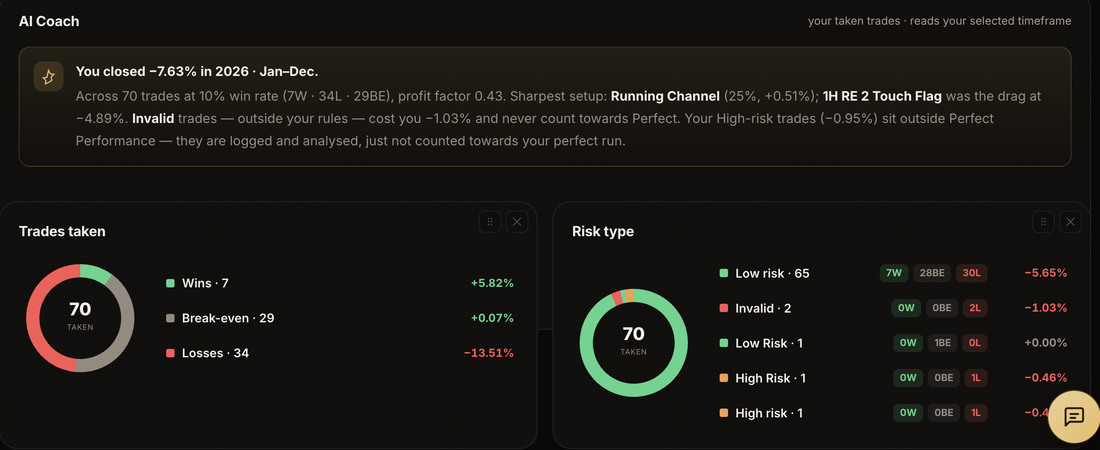
Exhibit A is a trading journal built around the six fields above — including the setups you didn't take — with the monthly review written for you by an AI coach that reads your own history. If you want to see what a filled-in month looks like before committing to anything, we published a sample trading journal with the numbers worked through.
Try it free for 14 days. No card needed to start.
Common questions
What should a trading journal include?
Setup name, planned risk, whether you followed your rule, the outcome in R, your state, and the setups you saw but skipped. Six fields. Anything beyond that should have to justify itself.
Is a trading journal really necessary?
You can trade without one. You cannot improve deliberately without one, because you have no way of telling a run of bad luck from a repeated mistake. Memory is not a substitute — it edits.
How often should I review it?
Weekly for a quick look at rule adherence, monthly for the real analysis. Reviewing after every trade encourages you to draw conclusions from single outcomes, which is the habit the journal exists to break.
Can I just use my broker statement?
It's a start, and it is genuinely useful for the arithmetic. But it records only what filled — not your reasoning, not your rule, and not the trades you talked yourself out of.