
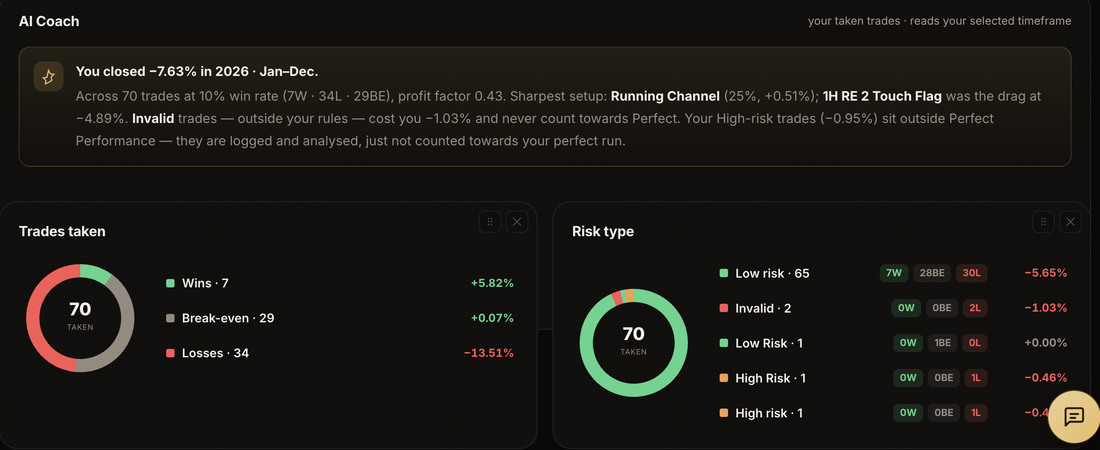
Max drawdown is the biggest drop your account has ever taken, from a high point down to a low point.
Say you grew an account to £12,000. Then it fell to £9,000 before recovering. Your max drawdown is 25%. And it stays 25% forever, however well you do afterwards.
It is the most useful number about a trading account, and the one people quote least.
Why it matters more than your win rate
Because losses and gains are not the same size.
If you lose 10%, you need 11% to get back. Annoying, but fine. If you lose 50%, you need 100% — you have to double what is left just to break even.
Have a play with this:
What does a loss really cost you?
Drag the slider to a loss. The big number is what you then have to make just to get back to where you started.
Recoverable. A normal run of good trades gets you back.
That curve is why professionals think about drawdown before returns. A system making 3% a month with a 12% worst case is a business. The same 3% a month with a 45% worst case is a coin flip that has not landed yet.
How to work yours out
Three steps. You can do it in one spreadsheet column.
- Track your highest balance so far. For every day, the best your account has ever been up to that point.
- Work out the gap. (highest − today) ÷ highest, as a percentage.
- Take the biggest one. That is your max drawdown.
Two things people get wrong here:
- Measure on equity, not closing balance. Otherwise open losing trades disappear from the record.
- Measure from your highest point, not your starting balance. Otherwise an account that doubled and then halved shows no drawdown at all.
Where is the floor?
If you trade a funded account, your firm sets a hard floor. Fall below it and the account is gone.
There are two kinds, and the difference catches people out. Try both:
Two rules, same trades, very different room
Here is one account over ten sessions. Switch between the two kinds of floor and watch what happens to the room you have left.
Look at what happens when you switch. Same trades, same account, same 10%. With a static floor you have £14,000 of room. With a trailing floor you have £6,800 — less than half, because the floor climbed while you were doing well.
That is why a trader who is up on the month can still be one bad session from failing. There is more on the variants here: prop firm drawdown, explained properly.
The number nobody works out: how long you were underwater. Days between your high point and the day you finally beat it. Depth tells you the risk. Time tells you whether you will still be trading the system when it recovers. Most people quit in the time, not the depth.
What counts as normal?
There is no universal answer, and be careful of anyone who gives you one. But:
- A drawdown two or three times your usual monthly gain is ordinary. It will happen.
- A drawdown you did not think was possible usually means your position sizing changed, not your strategy.
- No drawdown at all is not a good sign. It usually means too few trades, or you have not met a bad month yet.
Compare yourself to your own history, not to a benchmark. If your worst month used to be 8% and this year it is 19%, something changed in how you trade. The number tells you before your balance does.
Four things to do
- Track it live. One column, updated with your journal. Watching it move changes how you size. Reviewing it in January does not.
- Set your own limit below the firm's. If they fail you at 10%, decide the number where you stop and review. Make it smaller than theirs.
- Look inside your worst one. It is nearly always the same story: sizing up to win it back, in your weakest setup. A journal shows that. A balance does not.
- Write down the recovery time too. It predicts whether you will stick with the system better than the depth does.
That “sizing up to win it back” pattern above has a name, and it is worth knowing on sight: see how to stop revenge trading for what it actually looks like and the one habit that reliably breaks it.
Exhibit A tracks your drawdown, your recovery and how close you are to any firm's limit, alongside the rest of your trading journal — so you see the number while you are choosing your size, not afterwards. There is a full sample month if you want to see what the record looks like.
Try it free for 14 days. No card needed to start.
Common questions
What is a good max drawdown?
Smaller than the one that makes you give up on the strategy. In practice most retail traders should be uncomfortable above about 20–25%, because both the maths and the psychology turn hard quickly.
Does it reset when I make a new high?
Your current drawdown goes back to zero. Your max never resets. It is the worst thing that ever happened and it stays on the record. That is what makes it useful.
Balance or equity?
Equity. Balance ignores open losing trades, which is exactly where the risk you have not admitted to yet is sitting.
Is it the same as my daily loss limit?
No. A daily limit resets every day. Max drawdown builds up across the whole account. A funded account has both, and either one can fail you.